The Intersection of AI & CX
The current economic environment has triggered an evolution amongst CX leaders to produce new, innovative ways to improve customer experiences that not only protect, but increase revenue — while also demonstrating cost savings and more responsible spending.
To understand what initiatives to focus on, which actions will truly move the needle – brands will need to tap into new experience signals. Businesses need to go beyond a survey-centric, rigid CX program, and focus on integrating all insights into one platform, and transforming them into agile, business-wide strategic initiatives with clear ROI. In short, the market shift is emphasizing the fiscal responsibility each department has to an organization’s bottom line. As a result, CX professionals are looking to new and emerging technologies – Generative AI, augmented reality, NLP, and more. These innovations mean certain capabilities that previously required human direction will be automated, made more efficient, accessible. This reduction in costs and resources required to run a business provides the perfect market opportunity to give CX leaders more time back in their day for those high-impact, human-driven activities.
Artificial Intelligence: Breaking Down the Hype
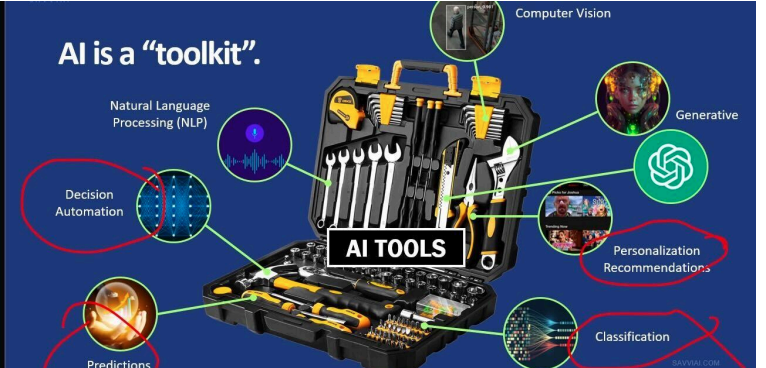
Artificial Intelligence is an umbrella term that encompasses a wide range of emerging technologies. With the unprecedented rise of Large Language Model technology and the release anniversary of Chat-GPT, the NLP field has made significant, unprecedented advancements while continuing to evolve at a breakneck pace. Given the ever-shifting nature of this industry, it can be helpful to think of AI as a toolkit, with all the various technologies serving as your tools to choose:
The Formula: NLG + NLU = NLP
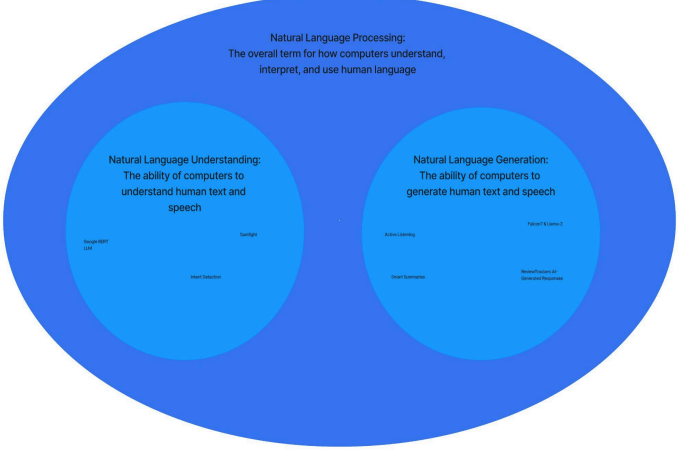
Natural Language Processing
The overall term for how computers understand, interpret, and use human language
Natural Language Generating
Like the namesake implies, NLG is technology that is generative in nature, it creates things. NLG is interacting with the AI, the development of chatbots and text generation. You can
discuss all sorts of interesting topics but it’s the use case we all wished for “I forgot I had a high school paper due tomorrow morning and sure wish I had someone to write it for me”. NLG uses an autoregressive transformer model that generates text sequentially in one direction. However, it can be extremely (and underhandedly) expensive to use GPT in a business (not to mention privacy concerns of data running through Microsoft’s Open AZURE system.
Natural Language Understanding
‘Natural Language Understanding’ is the other technology underneath the NLP umbrella – it
relies on similar underlying technology that is AI-driven and LLM-based, but not generative in nature. The base LLM that we use and build on top of for NLU is Google BERT given its
bi-directional ability to look for textual context “both ways”. Unlike the GPT autoregressive model which takes in and then generates text in a linear way, this LLM considers the prior and subsequent context of the inputted text to give the most holistic and accurate output of content understanding (i.e. qualitative analysis). In other words, BERT is able to consider “like” and “cake” in the sentence “i like chocolate cake” to understand the relationships between all the words in a sequence for the most accurate understanding.
Technology has finally caught up to the promise of Integrated CX – the insanely rapid advances in LLM based AI means it’s now possible to listen to all the feedback channels that drive a business.
 Business by Blaine
Leave a comment